As research becomes increasingly data-driven and computationally intensive, access to high-performance computing (HPC) is more important than ever. Wichita State’s BeoShock HPC Buy-In Program offers a sustainable, scalable way for research groups to meet these growing demands.

What is HPC good for?

HPC is ideal for solving complex problems that require large-scale computing power, including:

  • Scientific simulations (e.g., climate, fluid dynamics, particle physics)
  • Big data analysis (e.g., genomics, cybersecurity, social science)
  • Machine learning and AI model training
  • Image and signal processing
  • Engineering and economic modeling

How the Buy-In Program works

Research groups can purchase and contribute compute nodes to the BeoShock cluster. In return, they receive:

  • Priority access to their hardware
  • Faster job scheduling across the cluster
  • Efficient use of idle time

BeoShock uses Slurm, a job scheduler that ensures fair access. If another user is running a job on your node, Slurm will pause and reschedule it so your group can use the resource. Idle time is shared to maximize efficiency.

Real impact: Physics and the DUNE Collaboration

In 2024, the Physics Division within the Department of Mathematics, Statistics and Physics purchased a node with A30 GPUs to support graduate students working on the DUNE Collaboration, a major international experiment studying neutrinos. These students use BeoShock to simulate particle interactions and develop machine-learning models that will be used to detect neutrinos.

Support and sustainability

Participants benefit from:

  • Secure, climate-controlled space with backup power
  • High-speed networking and rack infrastructure
  • System administration and maintenance
  • Shared storage
  • Support from two system administrators and one application scientist for workload optimization

Note: Licensed software is purchased by individual research groups.

Why it matters

The Buy-In Program is one way to ensure WSU maintains a local HPC system well into the future. Each new contribution advances the technology available to campus researchers and makes you a key stakeholder in the shared computing infrastructure.

It also helps keep the campus network secure by reducing the number of isolated, privately managed compute clusters — centralizing resources in a professionally maintained environment.

Before rebuilding a computer lab with high-end GPU cards, consider investing in BeoShock HPC.
Centralized infrastructure offers better scalability, lower maintenance overhead, stronger security and access to expert support — without sacrificing performance.

Want to explore first?

If you’re unsure what kind of computational resources your research needs, try out national systems through the NSF’s ACCESS program, which offers free trial access to a wide range of platforms at access-ci.org.

If your group is interested in participating or learning more, contact Terrance Figy, director of HPC and associate professor of physics, terrance.figy@wichita.edu.

 

Join Undergraduate Research and Creative Activity Hub (UReCA) for an evening dedicated to undergraduate research, featuring networking, interactive sessions and a keynote address at a research mixer starting at 5 p.m. Oct. 20 in 305/306 Rhatigan Student Center, Beggs Ballroom.

Agenda highlights:

  • 5:15 p.m.: Networking session
  • 5:45 p.m.: “What is Research?” (for new researchers) and faculty panel: “What Makes a Standout Research Assistant?”
  • 6:30 p.m.: Real Talk: Undergraduate Students on Their Research Experiences & WSU Lab Highlights
  • 7 p.m.: Keynote address

The free event is open to faculty and undergraduate students. Food will be provided on a first-come basis.

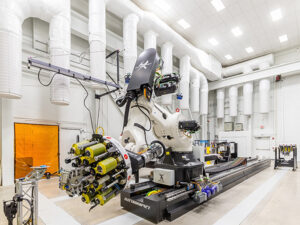
A multi-robotic manufacturing system inside NIAR's Advanced Technology Lab for Aerospace Systems

Several groundbreaking manufacturing research programs from Wichita State University’s National Institute for Aviation Research (NIAR) have been named finalists for the industry’s top honors by the Composites and Advanced Materials Expo (CAMX) and the American Composites Manufacturer’s Association (ACMA) Awards for Composites Excellence (ACE).

All five recognized research initiatives were conducted at NIAR’s Advanced Technology Lab for Aerospace Systems (ATLAS) as part of the Modeling for Affordable Sustainable Composites program, sponsored by the Air Force Research Laboratory.

Decorative Image: Office of Research Internal Grant Opportunity

Proposals are due to the Office of Research for Multidisciplinary Research Project Awards (MURPA) no later than 5 p.m. Friday, Oct. 3.

The MURPA opportunity provides funding of up to $7,500 for faculty projects that involve two or more investigators from different disciplines that focus different perspectives and capabilities on complex problems that intersect established areas of study. Proposers must work with a grant specialist in the Office of Research prior to submission and all complete applications require an endorsement from the chair and dean. Incomplete or late applications will not be reviewed or considered.

Email proposals@wichita.edu today to get started or visit the website for additional information.

Decorative Image: Office of Research Internal Grant Opportunity

Proposals are due to the Office of Research for University Research/Creative Award (URCA) projects no later than 5 p.m. Oct. 3.

The URCA opportunity provides funding of up to $4,500 for faculty to retool or reestablish productive research/creative projects or as seed money to develop pilot data where external funding is available. Proposers must work with a grant specialist in the Office of Research prior to submission and all complete applications require an endorsement from the chair and dean. Incomplete or late applications will not be reviewed or considered.

Please email proposals@wichita.edu today to get started or visit the website for additional information.

Promotional flyer for Wichita State University's I-Corps program. The flyer highlights opportunities to build innovation teams, secure funding, gain connections, and learn from experts.

Did you know over 60% of all start-ups fail, primarily due to lack of customers? I-Corps will help you evaluate the product-market fit. By helping teams connect with potential customers, strategic partners and key experts, the program will de-risk the pathway from innovative ideas to impactful products.

I-Corps is a vital part of the National Science Foundation’s mission to create and support a national innovation network. The program offers training to university researchers and community innovators who are interested in entrepreneurship education and mentoring, with the ultimate goal of reducing the time it takes to transform technologies from the laboratory to the market.

Through the NSF I-Corps program, participants can:

  • Gain valuable market insight to inform the next steps in research and/or development
  • Cultivate network connections and receive mentoring from experienced industry experts and entrepreneurs
  • Develop the entrepreneurial mindset and toolset needed to start a successful business

University-affiliated teams are eligible to apply to participate in the NSF I-Corps National Teams program and up to $50,000 in funding

All researchers and entrepreneurs in the region, including students, researchers, faculty and community entrepreneurs with deep technology ideas to bring to market are encouraged to apply.

Overhead photo of campus with a flag pole with the United States, Kansas and Wichita flags in the foreground and the campus in the background

Wichita State is one of the recipients of a renewed $20 million grant as part of the AI Institute for Foundations of Machine Learning (IFML), of which WSU is a founding member.

The grant will be awarded to the IFML institutions over the next five years and is used to support the development of more advanced generative AI that is open-sourced, which enables broader adoption and fosters innovation across a wide range of fields.

Dr. Kaushik Sinha, associate professor of computing in the College of Engineering, is the principal investigator for Wichita State’s $1.27 million share of the grant, which will be used to continue Sinha’s research and fund graduate students and support workforce development.

Wichita State engineering students collaborate on a prototype at the Project Innovation Hub.

Wichita State’s College of Engineering is expanding student innovation and applied learning opportunities through a new state-funded partnership with Groover Labs, a downtown Wichita makerspace and official WSU partner.

On July 15, the Kansas Department of Commerce named Groover Labs one of two recipients of the Accelerating Concept to Commercialization in Kansas (ACCEL-KS) grant. Groover Labs and KU Innovation Park in Lawrence will share $800,000 to support at least 32 early-stage commercialization projects across the state.