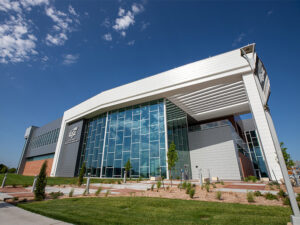
The front facade of the Hub for Advanced Manufacturing and Research

Wichita State University’s National Institute for Aviation Research (NIAR) officially opened its new Hub for Advanced Manufacturing and Research (HAMR) following a two-day grand opening event that brought together industry leaders, federal partners, Wichita State and NIAR employees, and the greater community.

The 170,000-square-foot facility is now open for industry and government research, development, training and collaboration. Located on Wichita State’s Innovation Campus, HAMR unites applied research, emerging technologies, advanced materials, digital engineering, precision machining and smart automation under one roof — expanding NIAR’s legacy as a global leader in innovation and workforce development.

Representatives from Wichita State University, Hexcel and the state of Kansas break ground on the new center

Wichita State’s National Institute for Aviation Research (NIAR), in collaboration with Hexcel Corporation, celebrated the groundbreaking of the new Hexcel Applications Center May 28. The center represents a significant milestone for Wichita State and further positions the university and Kansas as leaders in advanced aerospace research, manufacturing and workforce development.

The Hexcel Applications Center at NIAR’s Advanced Technologies Lab for Aerospace Systems (ATLAS) on South Oliver in Wichita further strengthens Kansas’ position as a global hub for aerospace research, design and manufacturing, while highlighting the importance of collaboration among industry, academia and government.

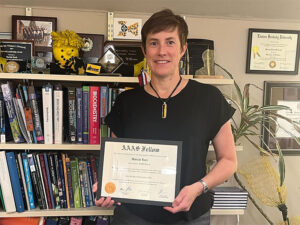
Moriah Beck holds up her AAAS Fellow plaque in front of a bookshelf full of various textbooks and research material

Dr. Moriah Beck, Talaty Endowed Research Professor of Chemistry and Biochemistry, has been elected a 2025 Fellow of the American Association for the Advancement of Science (AAAS), one of the world’s largest and most prestigious scientific societies.

Election as an AAAS Fellow is a lifetime honor that recognizes distinguished efforts to advance science or its applications. Fellows are chosen by their peers for scientifically or socially distinguished achievements and are expected to uphold the highest standards of professional ethics and scientific integrity.

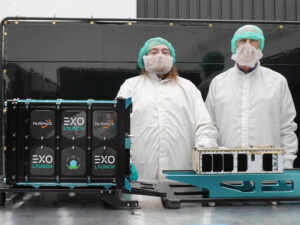
A student and a scientist in full clean garb stand next to the WSU CubeSat

On May 3, a solar detector prototype developed by Wichita State University will be launched by NASA into low Earth orbit, toward a potential future mission close to the sun. 

Integrated via Germany’s launch integrator Exolaunch, the CubeSat platform was built by NanoAvionics of Lithuania. It will carry and test the WSU-designed prototype solar neutrino detector into low Earth orbit to prove the detector can operate in space.

Dr. Nickolas Solomey, professor of mathematics, statistics and physics, leads the interdisciplinary project, which also includes Dr. Holger Meyer, professor of physics, Atri Dutta, associate professor of aerospace engineering, and Dr. Hyuck Kwan, professor of electrical engineering. Thirty-six graduate and undergraduate students, to date, have worked on the project since its start.

A watch party is scheduled for 1:30 a.m. Sunday, May 3 in 127 Jabara Hall. Students, faculty, staff and the public are invited to attend.

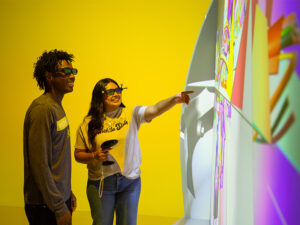
Students use augmented reality glasses to study airplane aerodynamics

Boeing is investing $380,000 to inspire the next generation of science, technology, engineering and mathematics (STEM) innovators, ensure that veterans and military families have the tools and resources they need to thrive, and to advance programs aimed at eliminating hunger.

Boeing’s investment includes five Wichita grant partners: Wichita State University, Wichita State University Campus of Applied Sciences and Technology (WSU Tech), the Kansas Aviation Museum, Passageways Wichita and the Kansas Food Bank.

“This grant helps prepare more students for careers in a rapidly changing industry while strengthening the talent pipeline in our region,” President Rick Muma said. “We’re grateful for Boeing’s continued partnership and its commitment to long-term impact.”

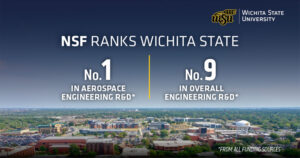
NSF ranks Wichita State No. 1 in aerospace engineering R&D and No. 9 in overall engineering R&D, from all funding sources

Fueled by a boost in contracts from federal agencies and various military branches, Wichita State University continues to hold strong in its standings in the National Science Foundation (NSF) Higher Education Research and Development Survey, reporting $392 million in research expenditures in the latest survey. This marks a 7% increase over the previous year’s $366 million, reinforcing WSU’s position as a leading research institution.

Specifically, Wichita State ranks No. 1 in aerospace engineering research and development (R&D) from all funding services with a total of $350 million, No. 2 in engineering R&D funded by industry and defense with $283 million, and No. 9 in engineering R&D from all funding sources with $360 million.

“The dedication and expertise of our researchers make these rankings possible,” President Rick Muma said. “Our consistent performance in research rankings continues to attract top talent and strategic partnerships to our university and state, continuing to position Wichita State as an economic driver for the state.”

Decorative Image: Office of Research Internal Grant Opportunity

Award for Research/Creative Projects in Summer (ARCS) proposals are due to the Office of Research no later than 5 p.m. Friday, Feb. 6. The ARCS opportunity provides funding of up to $4,000 to enable faculty to pursue research or creative projects during the summer.

Proposers must work with a grant specialist in the Office of Research prior to submission and all complete applications require an endorsement from the chair and dean. Incomplete or late applications will not be reviewed or considered. Email proposals@wichita.edu today to get started or visit the website for additional information.

The Innovation Campus at Wichita State University continues to grow with the addition of the Bureau of Alcohol, Tobacco, Firearms and Explosives (ATF) Wichita field office in Partnership Building 11.

The field office will open in Partnership Building 11, becoming the third building and operational space for the ATF on campus and further integrating the WSU School of Criminal Justice into the Innovation Campus ecosystem. This strategic co-location strengthens WSU’s nationally recognized applied learning model by embedding federal, state and local law-enforcement partners directly within the university’s interdisciplinary environment — creating expanded pathways for internships, case-based learning, collaborative research, laboratory engagement and hands-on investigative experience for students.

The addition of the field office further aligns with WSU initiatives to advance crime-gun-intelligence capabilities, enhance interagency collaboration and grow the criminal justice and forensic science talent pipeline for agencies regionally and across the nation.

Growing the relationship with the ATF means more opportunities for WSU students to learn from federal law enforcement professionals, contribute to meaningful work and discover career pathways. At the same time, the region gains talent, and our partners gain the workforce they need.

The ATF’s presence on campus strengthens our mission as a public research university and supports the safety and security of our community, our state and our nation.

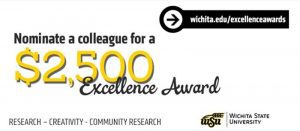
Nominate a colleague for a $2,500 Excellence Award graphic

Nominations for Excellence Awards in Research, Creativity Activity and Community Research are now being accepted by the Office of Research.

All full-time faculty, including distinguished professors and endowed chairs, who have served at WSU for at least three years are eligible. Faculty who hold an administrative position above that of chair are not eligible.

Previous winners of the award are ineligible to be nominated for a period of five years following the award. See the Office of Research website for additional details and online nomination forms. Nominations must be received by Dec. 5 to be considered.

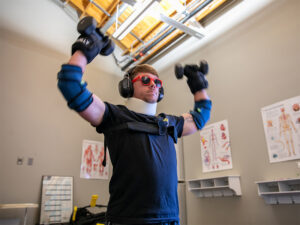
A physical therapy student at Wichita State University tests a homemade geriatric-simulation suit with wrist weights, dumbbells, elbow braces, sunglasses, earmuffs and a neck brace

When Wichita State physical therapy students strapped on sunglasses smeared with petroleum jelly, ankle weights and a stiff neck collar, the laughter came quickly. They shuffled around the room, testing their balance in flip-flops to mimic neuropathy and difficulty with walking, while leaning on friends as they struggled through simple tasks.

But as the exercises wore on, the fun gave way to frustration. Hearing became muffled under earmuffs. Vision blurred. Knees stiffened. Students who had just been joking about their new look began to feel something else: the physical and social isolation many older adults live with every day.

That shift — from amusement to awareness — is exactly what Dr. Justin Smith, assistant professor and board-certified geriatric clinical specialist, hoped for when he built a homemade geriatric-simulation suit and launched a pilot study to measure its effect on empathy in physical therapy students.