Join Interstellar Seminar from 2:30 to 3:20 p.m. Wednesday, May 1 in 104 Jabara Hall or online for the last session of the semester and see how science fiction is useful in crewed interstellar missions.

When looking towards interstellar travel in the distant future, science may not be ready to provide a clear vision. Science fiction can go outside the box and into the realm of what can only be imagined. Dr. Rachelle Smith — former professor of English, modern languages and journalism at Emporia State University, who specializes in science fiction — will provide insights into how science fiction can lead people into a science future that will rely on creativity before technology.

Zoom details and an archive of previous seminars can be found on the Wichita Space Initiative website.

Facility of language and the role of history during multigenerational missions to the stars will be discussed at Interstellar Seminar from 2:30 to 3:20 p.m. Wednesday April 24 in 104 Jabara Hall and online.

Communication is key for long-duration crewed missions. During multigenerational missions of 500 years or more, the languages brought will change as a new culture develops, very much different than Earth. Dr. Mythili Menon, director of linguistics at WSU, will join Interstellar Seminar to discuss the future of language, as humans travel to distant star systems.

Speeding away from home, the Earth will become a dot in space that eventually can no longer be seen. The history of the Earth will be preserved during an interstellar mission in some fashion, while a new history is being written. Dr. George Dehner, professor of history at WSU, will discuss the place history has for multigenerational missions that will never return to Earth.

Zoom details and an archive of previous seminars can be found on the Wichita Space Initiative website.

Nick Kanas headshot

Join Interstellar Seminar from 2:30 to 3:20 p.m. Wednesday, April 17 in 104 Jabara Hall or online to experience Dr. Nick Kanas’ talk on the psychology of interstellar travel.

The stresses of living in the wilderness of space are distinct from what we typically experience on the ground. Multigenerational missions to the stars will create unique challenges for mental health, interpersonal relationships and governance.

Dr. Kanas focuses on space psychology as an emeritus professor of psychiatry at University of California at San Francisco. He is an award-winning author and researcher and fellow of both the American Group Psychotherapy Association and the Royal Astronomical Society. Author of the leading textbook on space psychology and psychiatry, Dr. Kanas is also a celebrated science fiction novelist.

Zoom details and archived lectures can be found on the Wichita Space Initiative webpage.

Daniela de Paulis looking into a mirror

As humanity looks beyond the star system, it will need a culture of art and literature to provide perspective for those exploring and colonizing new frontiers. Join Interstellar Seminar from 2:30 to 3:20 p.m. Wednesday, April 10 in 104 Jabara Hall or online.

As an interdisciplinary artist, Daniela de Paulis works at the interface of the arts and sciences by collaborating with radio telescopes worldwide. Her performance art combines technologies and philosophies that advance astrobiology, neurobiology and new space through public engagement. She is a member of the IAA SETI Permanent Committee to better the search for extraterrestrial intelligence and to communicate across the universe through art.

Zoom details and archived seminars can be found on the Wichita Space Initiative webpage.

Dr. Jay Lemery in winter gear

Join Interstellar Seminar from 2:30 to 3:20 p.m. Wednesday, April 3 in 104 Jabara Hall and virtually to hear Dr. Jay Lemery, professor of emergency medicine at the University of Colorado School of Medicine, discuss space medicine for long-duration crewed missions.

Deep space is the ultimate wilderness environment for austere and remote medical care. Dr. Lemery is a leader in public health related to climate and in wilderness medicine. Dr. Lemery is the medical director for the NSF Polar Research program, a consultant for NASA’s Human Research program, a fellow at the Payne Institute for Public Policy and an elected member of the National Academy of Medicine.

Grant Anderson headshot

Join Interstellar Seminar from 2:30 to 3:20 p.m. Wednesday, March 27 104 Jabara Hall or online as Grant Anderson, founder and leader of Paragon Space Development Corporation, talks about living in space.

Long-duration crewed missions require closed-loop life support systems to provide breathable air and palatable nutritious food. Everything must be closely recycled since there may be no chance of resupply for decades. Spacecraft architecture must be comfortable and protected from the harsh space environment.

A visionary engineer and entrepreneur, Anderson has worked on crewed missions from the Shuttle program to the International Space Station and is now developing the Gateway station that will orbit the Moon.

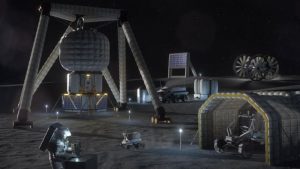
Space colony

Join Interstellar Seminar for a discourse on the ethical questions that surround multi-generational missions to the stars from 2:30 to 3:20 p.m. Wednesday, March 20 in 104 Jabara Hall and online with Dr. JS Johnson-Schwartz, assistant professor of philosophy.

How does society articulate and defend the intrinsic value of the knowledge gained from space science in the context of planetary stewardship? How does it frame the questions that lead to the ethical principles defining permissible human space settlement?

Dr. Johnson-Schwartz studies the philosophy and ethics of space exploration at WSU, touching on space policy, law, inclusivity, the environment and metaphysics. A prolific author, she is a thought leader on the epistemic values of space exploration, exploitation and settlement.

Alex Ellery

Dr. Alex Ellery, a mechanical and aerospace engineer from Carleton University in Ottawa, will join Interstellar Seminar from 2:30 to 3:20 p.m. Wednesday, March 6 in 104 Jabara Hall and online to discuss in-situ resource utilization, space manufacturing and the interplanetary economy.

Regenerating spacecraft during multigenerational voyages, when there is no chance of resupply, requires ingenuity, planning and flexible additive manufacturing.

Ellery’s work touches on space robotics, biomimetic design, autonomous systems, lunar mining and self-regenerating von Neumann probes. Find zoom details and an archive of past Interstellar Seminars on the Wichita Space Initiative webpage (wichita.edu/space).

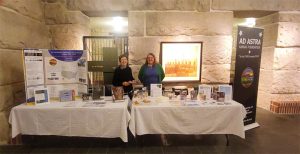
Display Booth in Kansas State Capitol Rotunda

Ad Astra Kansas Foundation (AAKF) presented information on space education in Kansas at a booth in the Kansas State Capitol Rotunda Feb. 7, and Interstellar Seminar, a course at Wichita State, was featured in the presentation as the first Interstellar University course.

Interstellar Seminar is a non-majors, non-technical course, open for free to the public, which remotely brings to campus world-renown speakers on diverse topics in space science and humanities related to interstellar travel. Learn more through Wichita Space Initiative.

Cosmosphere is the home of AAKF, which brings space science education to the community through events such as their annual Galaxy Forum. One initiative is Interstellar University, a collaboration with Space Age Publishing.

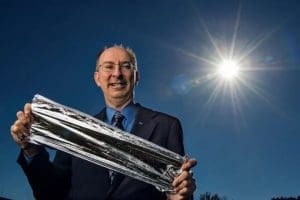
Les Johnson holding a piece of solar sail

Conventional rockets will not take humans to the stars; interstellar travel requires advanced propulsion, from solar sails to antimatter drives. Les Johnson, NASA rocket scientist, will join Interstellar Seminar from 2:30 to 3:30 p.m. Wednesday, Feb. 28 in 104 Jabara Hall or online via Zoom.

Johnson is a leader in the Interstellar Research Group, a true futurist. In addition to being a physicist and mission scientist, Johnson writes popular books on interstellar travel and science fiction novels.