Black and white headshot of a white woman wearing glasses, a dark sweater, and with a bob haircut

Mia Ocean, Associate Professor in the School of Social Work, published “Anti-Oppressive Critical Participatory Action Research and Ethics in US Postsecondary Education” in Critical Participatory Action Research in Higher Education Aug. 26.

Abstract: Anti-oppressive Critical Participatory Action Research is a strengths-based, growth oriented, and capabilities-focused epistemology. Anti-oppressive Critical Participatory Action Research coalitions prioritize power-sharing, relationships, and populations that society attempts to marginalize. Being an anti-oppressive researcher signals a professional and personal commitment to participants and communities and an undertaking to challenge traditional research processes and outcomes that reproduce societal inequities. Anti-oppressive Critical Participatory Action Research is an opportunity to engage in lifelong learning and equity-focused change. In this chapter, the mindset needed to conduct anti-oppressive Critical Participatory Action Research is described, terminology is defined, and several research approaches are explored. The chapter concludes by amplifying a handful of specific capabilities that can be advanced iteratively over time in Critical Participatory Action Research efforts.

Masud Chand, Professor in the Department of Management, was recognized with 2024 Top Scholar from ScholarGPS.

Neal Allen, Associate professor in the Department of Political Science, was recognized with Faculty Fellowship from ENACT.

Sun Young Lee, associate Professor in the School of Education, published “Transpacific Curriculum History: Undoing the Citational Practice of Global Whiteness in Education Reforms” in Harvard Educational Review Feb. 21.

Abstract: In this article, Sun Young Lee presents a critical analysis of global whiteness, explicating how citational practices rooted in white-centric perspectives perpetuate epistemic coloniality in education reforms. Drawing on critical transpacific studies and critical whiteness studies, this study problematizes US educational imperialism for reinforcing global whiteness through universalized configuration of educational theories. To challenge its continuity, Lee first historicizes the paradoxical outcomes of postcolonial education reforms in South Korea, which aimed to counter Japanese imperialism but inadvertently reimperialized the systems of educational knowledge with US-centric epistemes. Lee then specifies how citational practices on US-centric progressivism, including John Dewey’s theories, have shaped the epistemic possibilities for new education initiatives in South Korea. Pointing out the white-centric racialized origins in progressive ideas, Lee engages in historicizing as a critical methodology to reevaluate the humanitarian ideals of national education as embodying globally mobilized white-centric norms. The article concludes by calling for transpacific studies in education research, emphasizing both deconstruction and reconstruction of epistemic possibilities through reimagined global interconnectivity and nonlinear temporality toward equitable futures of educational change.


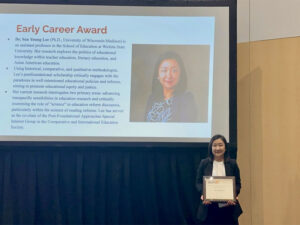
Dr. Sun Young Lee at the AERA CICCS Early Career Award Ceremony

Sun Young Lee, Assistant Professor in the School of Education, was recognized with 2025 Early Career Award from the American Educational Research Association’s Critical Issues in Curriculum and Cultural Studies.

Jeff Hayton, Associate Professor in the Department of History, published “The Path of Gratitude: East German Climbers in North Korea’s Diamond Mountains” in German Studies Review May 1.

Abstract: This article investigates the origins, course, and experiences of two East German mountaineering expeditions to North Korea in the 1980s. Examining how expedition members understood and processed their encounters with socialism in the Far East, it explores how their experiences with time and space as well as dictatorship and modernity in North Korea led them to ponder the nature and future of state socialism back home in the German Democratic Republic.

Davood Askari — Associate Professor in the Department of Mechanical Engineering — was featured in “This ‘jungle’ of coiled nanotubes could lead to tougher composites” in Aerospace America.

Davood Askari, Associate Professor in the Department of Mechanical Engineering, was featured in:

The Office of Civil Rights, Title IX, & ADA Compliance (CTAC) has invited two finalists for the position of director of ADA & Section 504 compliance to campus for interviews Wednesday, Sept. 10 and Thursday, Sept. 11.

Each candidate will facilitate a presentation outlining how they intend to lead ADA compliance and accessibility efforts at an institution of higher education in 2025. Presentations will begin at 12:45 p.m. and conclude at 1:45 p.m. with an open Q&A session.

To RSVP, contact Linda Sims, executive assistant for CTAC, at linda.sims@wichita.edu.

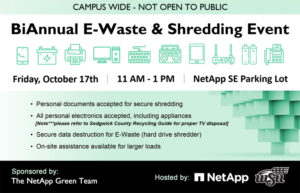
Biannual e-waste and shredding event

Faculty, staff, students and campus partners at Wichita State can visit NetApp on the Innovation Campus for its semesterly campus e-waste and shredding event from 11 a.m. to 1 p.m. Friday, Oct. 17 in the NetApp parking lot, lot 44S. This event is exclusive to WSU faculty, staff, students and campus partners and not open to the public.

The following are items that can be disposed of during the event:

  • Personal documents accepted for secure shredding
  • All personal electronics accepted, including appliances
  • Secure data destruction for e-waste (hard drive shredder)
  • On-site assistance available for larger loads

The event is sponsored by the NetApp Green Team.